
Estrogen on Your Face: Does It Actually Work?
By Glow Health | Menopause & Sexual Health Specialists
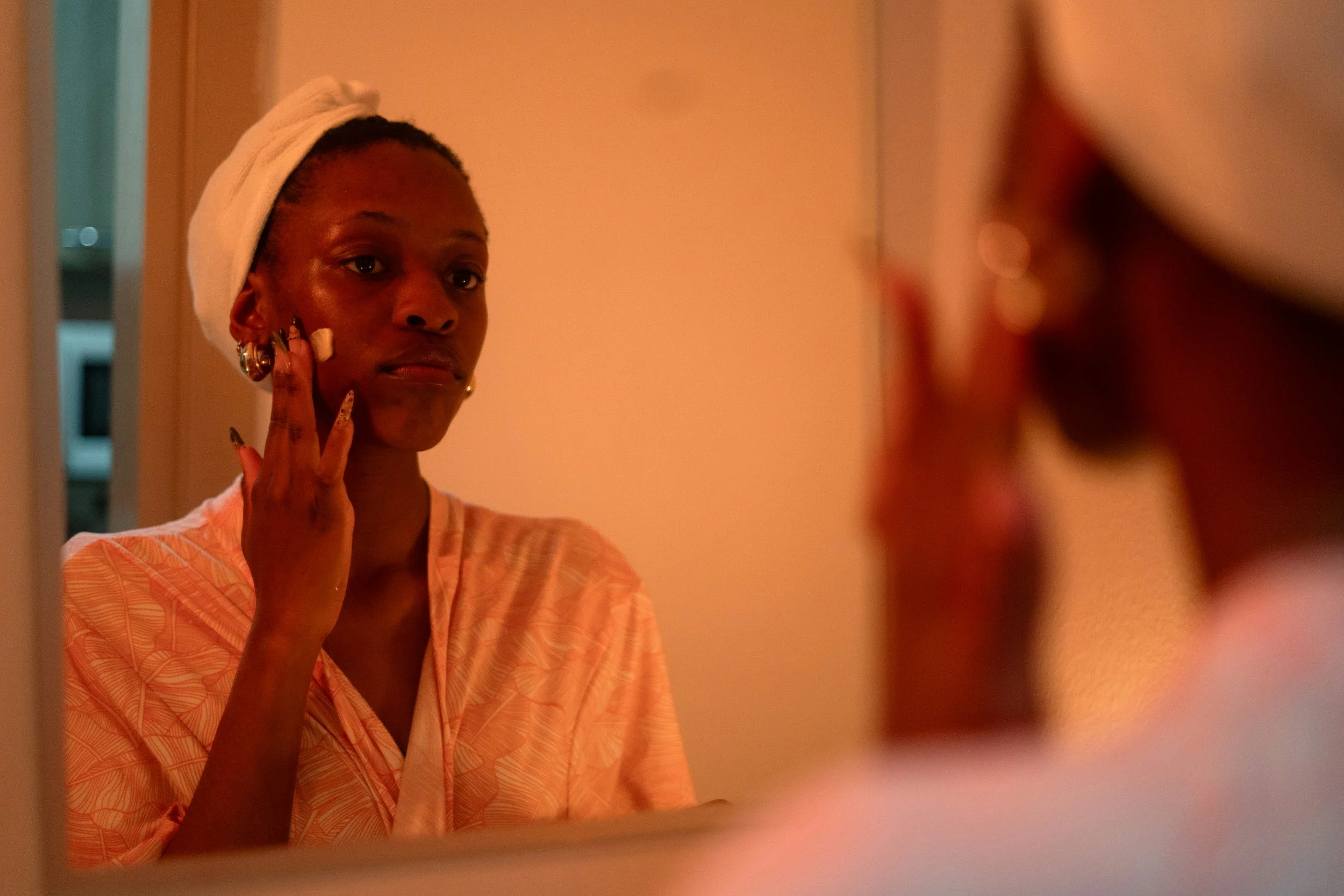
If you have spent any time in menopause communities online, you have probably come across women talking about applying estrogen cream to their faces. Some have been doing it quietly for years. Others are curious but not sure whether there is any science behind it. And many clinicians who work in menopause medicine recommend it regularly.
So what does the evidence actually say? The answer is more nuanced than either the enthusiasts or the skeptics suggest, and understanding it requires thinking about facial aging in a way that goes beyond wrinkles and skin texture.
Why estrogen matters for the face
Your skin is loaded with estrogen receptors. This means it is not a passive bystander to your hormonal status. It responds directly to estrogen levels, and when those levels drop at menopause, the effects on the face are real and measurable.
As discussed in our post on menopause and your skin, collagen drops by approximately 30% in the first five years after menopause, with losses continuing at around 2% per year thereafter. Skin thins. It loses moisture and elasticity. Wound healing slows. These changes are driven in significant part by estrogen loss, which is why the question of whether putting estrogen back, either systemically or directly on the skin, can reverse them is a reasonable one.
What the topical estrogen studies show
The most frequently cited evidence for applying estrogen directly to the face comes from two studies by Schmidt conducted in the mid-1990s. In the larger trial, 59 perimenopausal women applied either 0.01% estradiol cream or 0.3% estriol cream to their faces daily for six months. Both groups showed meaningful results: wrinkle depth decreased by 61 to 100% using objective measurements, skin elasticity and firmness improved, pore size decreased, moisture increased, and in the ten women who had small skin biopsies taken, collagen increased under the microscope.
Those are genuinely compelling numbers. The significant limitation is that these studies had no placebo control group. Without a comparison arm of women applying plain cream, it is difficult to know how much of the improvement was attributable to estrogen specifically versus the general benefits of paying more attention to one's skin, moisturizing more consistently, and using sunscreen more diligently.
A stronger piece of evidence comes from a 2017 randomized controlled trial by Silva, which compared topical estrogen to a plant-based alternative on the facial skin of 30 postmenopausal women over 24 weeks. Estrogen outperformed the comparison and demonstrated actual increases in collagen synthesis in facial skin biopsies. That is meaningful.
One study that occasionally gets cited as evidence against topical estrogen is the 2014 Yoon study, which used a cream containing estrone on sun-damaged facial skin and found no improvement, along with an increase in an enzyme that breaks down collagen. This sounds alarming until you know that estrone is a different estrogen from estradiol and estriol. Estradiol is the most potent, estriol is the gentlest, and estrone behaves differently enough that you cannot draw conclusions about one from a study done on another. The Yoon findings almost certainly do not apply to the low-dose estradiol or estriol preparations that are used in practice.
The honest summary of the topical estrogen evidence: the biological rationale is solid and the best studies are encouraging. The evidence base is small, the study designs are inconsistent, and the time frames are short. It is not the kind of evidence that would satisfy a regulatory agency, but it is enough for a clinician who understands the biology to consider it a reasonable option.
What systemic estrogen does for skin
For women already using hormone therapy for other reasons and wondering whether it is also helping their skin, the data here are mixed.
The largest and most rigorous study on this question is the KEEPS Ancillary Skin Study, which followed recently menopausal women for four years and randomized them to low-dose oral conjugated equine estrogen, an estradiol patch, or placebo. Wrinkles and skin firmness were measured at eleven facial sites. The result: no significant difference between the hormone therapy groups and placebo after four years. That is a well-designed study with a disappointing answer, though the doses used were relatively low, which may have affected the outcome.
Smaller studies are more encouraging. A 2007 trial by Sator found improvements in skin elasticity and thickness after seven months of 2 mg oral estradiol. A 2015 comparison study of long-term hormone therapy users versus non-users found that the hormone therapy group had notably more elastic skin and fewer wrinkles.
The most honest take: systemic estrogen probably does something good for skin, the effect is real but modest, it likely works better the earlier you start, and it varies considerably between women. Skin improvement is a welcome bonus of hormone therapy, but it is not a primary reason to start it.
The part nobody talks about: fat and bone
Here is where the conversation about estrogen and facial aging gets genuinely interesting and is largely missing from mainstream skincare discussions.
Wrinkles are not the main reason faces look older. They are part of the story, but the bigger part is volume loss. Cheeks that used to be full start to hollow. The under-eye area deflates. The temples indent. That soft, three-dimensional quality of a younger face gradually disappears. This is not primarily skin sagging. It is fat disappearing or redistributing.
Estrogen acts as a brake on fat breakdown in subcutaneous areas, the fat that sits just under the skin. When estrogen disappears at menopause, that brake releases. Fat migrates from peripheral areas toward the center of the body, and research shows this redistribution accelerates dramatically around menopause. Women on hormone therapy have concentrations of estrogen in their fat tissue that are four to seven times higher than those of women not using it. What that means specifically for the fat pads in the face is still speculative, but no serum, retinoid, or topically applied estrogen cream touches this mechanism.
The bone story is equally important. A 2019 study by Windhager analyzed facial shape changes in 88 people aged 26 to 90 using detailed three-dimensional measurements. Men and women aged similarly until around age 50, at which point the female trajectory took a sharp turn. In postmenopausal women, the primary driver of facial shape change was jawbone loss. The changes included a flatter face, drooping soft tissue, and a softer, less-defined jawline, and the speed of facial shape change was higher in women than men, accelerating in early postmenopause.
Further research has found that a three-year clinical trial showed hormone therapy significantly increased jaw bone density compared to placebo, and that women who had never used hormone therapy had twice the odds of significant jawbone loss compared to those who had.
The skeleton of the face is the structure that everything else hangs from. Skin, fat, and fascia all depend on the underlying bone staying reasonably intact. When it doesn't, no skin serum, injectable filler, or topically applied estrogen cream will address what is happening at the structural level. For facial bone preservation, systemic estrogen is the relevant intervention. A dab of vaginal cream on the cheek is not getting deep enough to do anything for the jaw.
A note on melasma
Estrogen can stimulate pigment-producing cells in the skin, which raises the reasonable concern that applying it to the face might trigger melasma, the brownish patchy discoloration some women develop during pregnancy or on hormonal contraceptives.
The actual evidence here is more reassuring than the theoretical concern. A 2026 systematic review found that topical estrogen has very little documented association with melasma, unlike oral hormone therapy, which has more case reports. The Schmidt studies reported no pigmentation problems. The mechanism appears to require both estrogen and UV exposure working together, which makes sunscreen non-negotiable when using topical estrogen on the face. Women with a personal or family history of melasma, or whose skin darkened during pregnancy or on the pill, should proceed cautiously and monitor carefully.
How does topical estrogen compare to retinoids?
Tretinoin, the prescription-strength retinoid, has something topical estrogen does not: decades of robust evidence, FDA approval for skin aging, multiple large randomized controlled trials, and a 2025 analysis covering nearly 4,000 patients across 23 studies. Retinoids consistently stimulate collagen production, thicken the skin, improve cell turnover, and produce histologically confirmed changes in skin structure. As a primary skin treatment, retinoids have a significantly stronger evidence base.
But this comparison misses something important. Retinoids work on the surface. They improve the dermis and epidermis. They treat sun damage. What they cannot do is preserve the fat pads that give the face its volume, maintain the bone structure of the jaw, or address the deeper architectural changes that estrogen was quietly preventing for decades. Retinoids and estrogen work on completely different levels, and neither can do the other's job. For women who want to address facial aging comprehensively, both may be relevant.
The practical bottom line
Applying low-dose estradiol or estriol to the face is probably helpful. The biological rationale is solid and the best studies we have are encouraging. If you try it, use estradiol or estriol rather than estrone, keep concentrations low, wear sunscreen daily without exception, and watch for pigmentation changes if you have that history. Go in with realistic expectations, because the evidence base, while encouraging, is still limited in scale and design. It is a treatment that makes biological sense and has a reasonable enough signal in the literature to be worth considering.
The more important piece of the facial aging picture, however, is what is happening underneath. Systemic estrogen, started reasonably close to menopause and maintained, likely slows the structural loss of facial fat and bone that no topical product can address. The bone story of facial aging is underappreciated and practically invisible in mainstream conversations about skin. But it is, in many ways, the most important story of all.
How Glow Health can help
At Glow Health, we take a comprehensive view of how hormonal changes affect the whole body, face included. If you have questions about topical estrogen, systemic hormone therapy, or the broader picture of how to protect your skin and facial structure during the menopausal transition, we welcome that conversation.
Keywords: estrogen face cream, topical estrogen face, estrogen skin aging, estrogen cream face menopause, estradiol face, estriol face cream, menopause skin estrogen, estrogen facial aging
This post is for informational purposes only and does not constitute medical advice. Please consult a qualified healthcare clinician for personalized guidance.
